
Inserting an explicit section about charity resilience into your Charity Strategic Plan can be useful to reassure stakeholders. It also signals commitment (the how) to achieve long-term, charity sustainability.
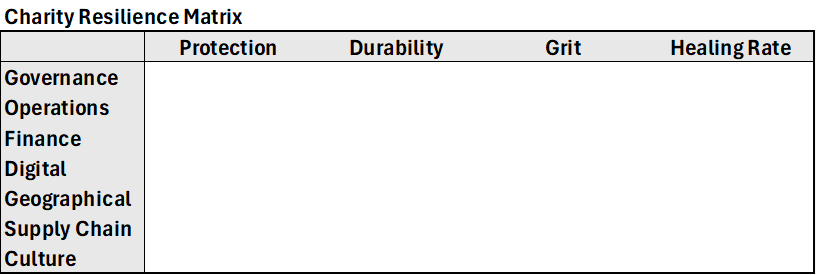
A generic, working definition of resilience is that it includes 4 key components: protection, durability (wear and tear), (human) grit and healing rate. Charity resilience can also be divided into various areas: governance, operations, finance, digital, geographical, supply chain and cultural.
Creating a matrix of rows and columns covering the 4 components and the 7 areas can be insightful to identify gaps and opportunities to strengthen resilience further.
Further, it’s possible to invest in resilience improvements that benefit more than one area. For example, ethics and technical training benefit both governance (risk oversight) and cultural resilience (reputation protection).
How is charity resilience linked to the charity risk register?
The charity risk register catalogues key risks, their owners and their mitigations. Charity resilience is an end-goal and a necessary condition to achieve the Charity Strategic Plan. Some charity risks relate to threats to resilience. By mitigating those risks, the probability of charity resilience is increased.
Resilience can be expressed as a current state and a target improved state. Risk scores in the risk register tend to be a snapshot in time. With risk appetite representing the target risk score in its totality.
Charity Resilience Assessment
Some independent assessments of charity resilience (impartial assessments can calm the critics) may come from the sector regulator, a bank lender (charity credit rating), insurance risk assessment, or the auditors. An example of the later would be the auditors’ feedback on internal controls and going concern.
It follows that achieving improved charity resilience can reduce risk for those suppliers, leading to lower fees, cheaper credit, or less extensive audits.
Feel free to reach out to Charity Strategy Together for help on developing charity resilience further.
Simon
Leave a Reply